
Education
Safeguarding
The safety and well-being of everyone in our sport comes first. If you have a concern, tell us — you do not have to be certain to report.
Urgent concern
If a child or adult is in immediate danger, call the police on 999. You can also contact the NSPCC Child Protection Helpline on 0808 800 5000.
For all other safeguarding concerns, contact the Kickboxing GB safeguarding team directly:
- Email: safeguarding@kickboxinggb.com
- Phone: 01628 415923
Please do not send confidential safeguarding details through a general enquiry form. Email or phone the safeguarding team so your report reaches the right people.
Kickboxing GB has designated personnel you can speak to if you have concerns about poor practise or suspect that a child or vulnerable adult may be being abused or is at risk. The first point of contact is our Lead Safeguarding Officer Linda Baxter with the President Peter Edwards as a point of escalation should the need arise:
At Kickboxing GB, we take the safety and well-being of our members very seriously. We are committed to providing a safe and secure environment for all participants, ensuring that they can enjoy the benefits of kickboxing with peace of mind. Safeguarding is at the forefront of our organisation, and we continuously educate our staff, instructors, and members on best practices to identify and prevent any potential risks or concerns. We believe that education is key to maintaining a supportive and inclusive community, and we strive to equip everyone involved with the knowledge and tools necessary to create a positive and protective atmosphere.

DBS checks
DBS rules changed on 1 September 2026. The exemption that allowed supervised assistant coaches and volunteers to work in regulated activity without a check has been removed. This means a person can now be undertaking regulated activity with children even when they are being supervised.
The frequency threshold has also changed. It is now more than 3 days in any 30-day period — that is, 4 or more days. Days are counted across all the clubs, schools and organisations a person works with, not one by one.
Where a coach, instructor, official or volunteer falls within the new definition, an Enhanced DBS check with the children's barred lists may be requested. A barred-list check is possible but not automatic — it depends on the activity the person carries out. Clubs should review their current arrangements and make sure everyone who now needs a check has one before they continue in role.
Full details: the government guidance is at www.gov.uk/government/news/change-to-the-definition-of-regulated-activity-with-children-from-1-september-2026. If you are unsure whether a role needs a check, contact the safeguarding team before the person starts. DBS checks are a mandatory requirement for all Kickboxing GB volunteers.
Training
Safeguarding awareness is a mandatory requirement for all Kickboxing GB coaches from grassroots through to our elite levels. Whilst safeguarding certification can be attained by any recognised 3rd party provider Kickboxing GB recommends the safeguarding and protecting children courses delivered by UK Coaching.
UK Coaching’s mission is to inspire and support coaches to deliver great coaching through best practice, training, research and industry standards across sports, communities and national governing bodies. For over 25 years UK Coaching have worked with the NSPCC’s Child Protection in Sport Unit (CPSU) to set the right standards and raise awareness among coaches of how to recognise and respond to matters of safeguarding children.
They have also partnered with The Ann Craft Trust to offer learning on how to support and promote the welfare of adults at risk, and with the CPSU on training for welfare officers. Click here for more information about UK Coaching…
Accident reporting
Instructors: report an accident
Approved instructors can report accidents and follow up their reports in the instructor area. Attend to the injured person first — this is not an emergency service.
Instructor areaConcussion guidelines
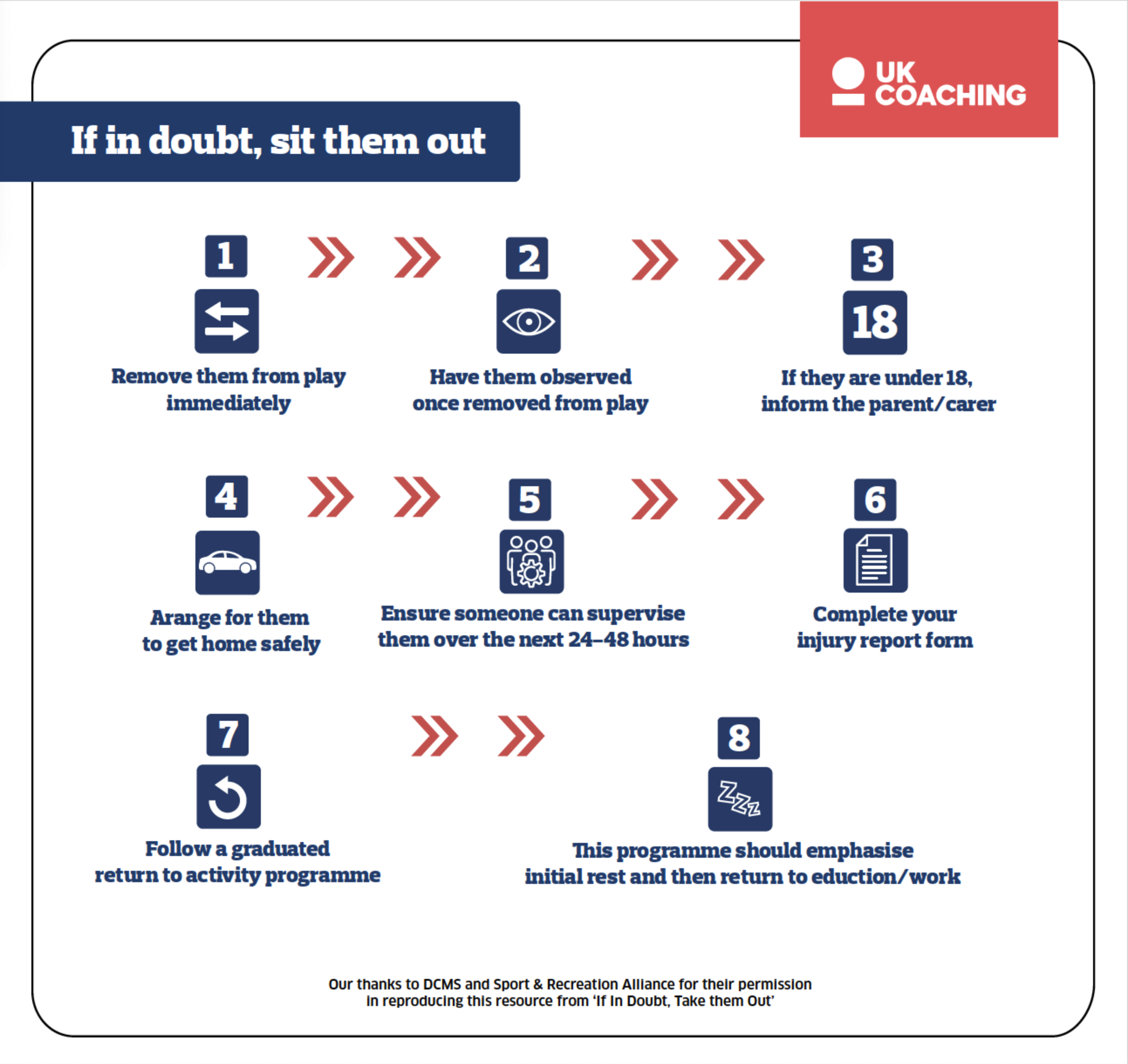
If in doubt, sit them out. No one should return to sport within 24 hours of a suspected concussion.
Concussion Guidelines
If in doubt, sit them out’ is the strapline for the UK Governments concussion guidelines, making clear no-one should return to sport within 24 hours of a suspected concussion and builds on guidance already introduced in Scotland.
Players, parents, coaches, teachers and administrators are now asked to read the guidance and familiarise themselves with the necessary steps to:
- RECOGNISE the signs of concussion;
- REMOVE anyone suspected of being concussed immediately and;
- RETURN safely to daily activity, education/work and, ultimately, sport.
UKGUIDELINESFORALLGRASSROOTSSPORTS
The Department for Digital, Culture, Media and Sport in collaboration with the Sport and Recreation Alliance have published guidelines to better protect athletes from the devastating effects of head injuries and concussion advising: “if in doubt, sit them out”.
The UK Concussion Guidelines for Non-Elite (Grassroots) Sport can be viewed here.
Graduated Returnto Activity
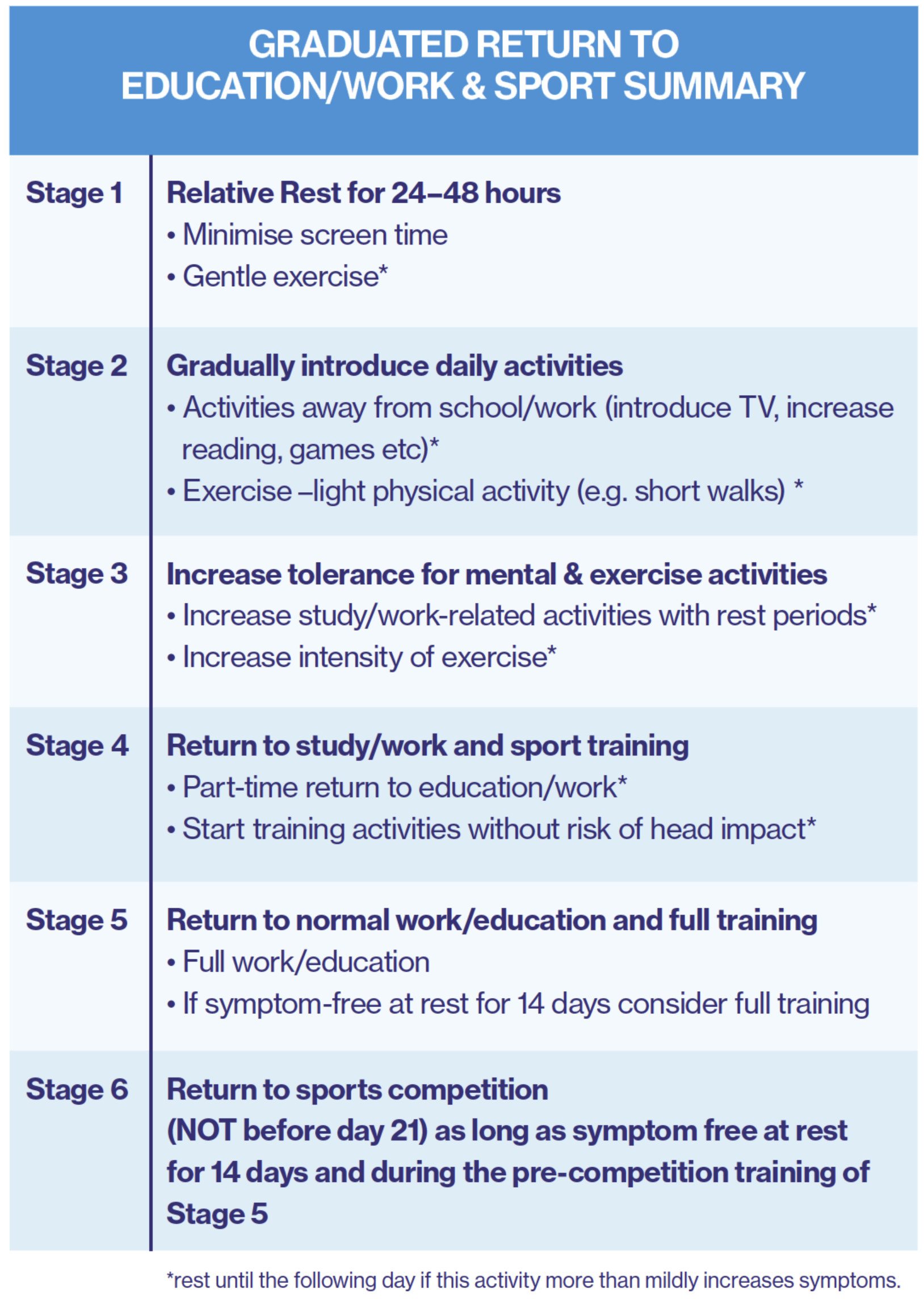
Generally, a short period of relative rest (first 24-48 hours) followed by a gradual stepwise return to normal life (education, work, low level exercise), then subsequently to sport is safe and effective.
Progression through the stages below is dependent upon the activity not more than mildly exacerbating symptoms. Medical advice from the NHS via 111 should be sought if symptoms deteriorate or do not improve by 14 days after the injury. Those with symptoms after 28 days should seek medical advice via their GP.
Participating in light physical activity is beneficial and has been shown to have a positive effect on recovery after the initial period of relative rest. The focus should be on returning to normal daily activities of education and work in advance of unrestricted sporting activities.
I f symptoms continue beyond 28 days remain out of sport and seek medical advice from a GP.
Contacts
Director for Welfare and Governance
Gordon Mitchell
Lead Safeguarding Officer
Linda Baxter
Medical Officer
Jess Smith
Health & Safety Officer
Linda Baxter
Medical documents
Safeguarding downloads & policies
| Document | Published |
|---|---|
| Child Protection Policy StatementPDF | February 2025 |
| Safeguarding Children PolicyPDF | March 2025 |
| Safeguarding Adults PolicyPDF | February 2025 |
| Safeguarding Safe Practise PolicyPDF | August 2025 |
| Safeguarding Travel PolicyPDF | February 2025 |
| Photography and Filming PolicyPDF | February 2025 |
| Safeguarding Code — Step by Step Guide for ClubsPDF | February 2025 |
| Safeguarding Incident Report FormPDF | February 2025 |
| Coaches Code of ConductPDF | February 2025 |
| Parents Code of ConductPDF | February 2025 |
| Children and Young Persons Code of ConductPDF | February 2025 |
| Referee Code of ConductPDF | February 2025 |
| Handling of DBS Certificate Information PolicyPDF | February 2025 |
These are the original published files. Where a policy existed in both a January 2025 and a February/March 2025 version on the old site, the later version is shown.